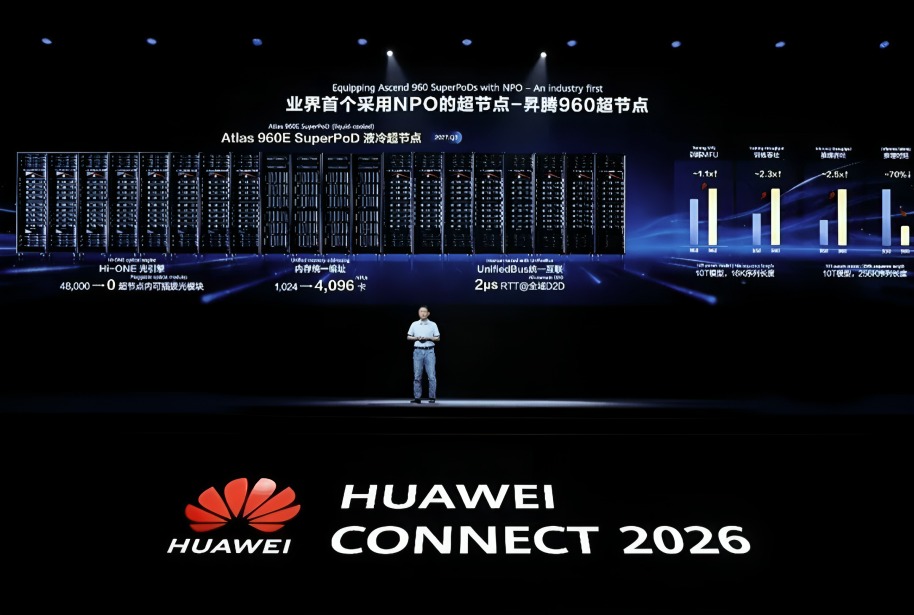


Huawei has unveiled the Atlas 960E SuperPoD at HUAWEI CONNECT 2026 in Shanghai, introducing what the company describes as the industry’s first NPO-based SuperPoD designed to accelerate the training and inference of models with up to 10 trillion parameters.
David Wang, Deputy Chairman of the Board and Rotating Chairman at Huawei, announced the system during his keynote, “Advancing the Agentic World, Building a Solid Silicon Foundation.”
Huawei’s AI strategy is focused on building computing infrastructure around its silicon technologies, with SuperPoDs and SuperClusters positioned as key components of its approach to supporting increasingly large foundation models.
The Atlas 960E SuperPoD is powered by Huawei’s UnifiedBus and Hi-ONE technologies and uses an advanced orthogonal architecture with full liquid cooling. The system can scale to 4,096 NPUs and deliver up to 8 EFLOPS at FP8 precision and 16 EFLOPS at FP4 precision.
Huawei said the system integrates 5,500 Hi-ONE optical engines, reducing the need for the 48,000 800G optical modules traditionally required to connect the NPUs. According to the company, this design cuts power consumption by more than 550 kilowatts and doubles fault-free operating time, reaching 99.8% system availability.
The Hi-ONE optical engine is described by Huawei as the world’s first mass-produced NPO optical engine. It provides transmission capacity of up to 7.2 Tbit/s and includes an integrated light source.
Huawei has also extended its SuperPoD architecture beyond AI acceleration. The upgraded TaiShan 950 SuperPoD supports up to 4,096 nodes and a unified memory pool of up to 256 TB, while the OceanStor M900 provides a UnifiedBus-powered context memory storage cluster with a petabyte-scale KV cache.
Multiple Atlas 960E SuperPoDs can be connected through UnifiedBus or RoCE to create larger SuperClusters. Huawei said its two-tier, four-plane Clos architecture can interconnect up to 512,000 NPUs, while a multi-rail topology can support clusters of up to one million NPUs.
Alongside hardware development, Huawei is expanding its open-source approach. The company said CANN is now open source and moving toward sustained, community-driven development to support the wider Ascend ecosystem.
HUAWEI CONNECT 2026, themed “Advancing the Agentic World,” is exploring AI through strategy, technology and ecosystems. The event is being held from September 17 to 19 at the Shanghai World Expo Exhibition & Convention Center and Shanghai Expo Center.