

Egypt is advancing plans to expand digital government services, strengthen digital infrastructure and increase outsourcing exports as the country continues to position technology as a driver of economic growth.
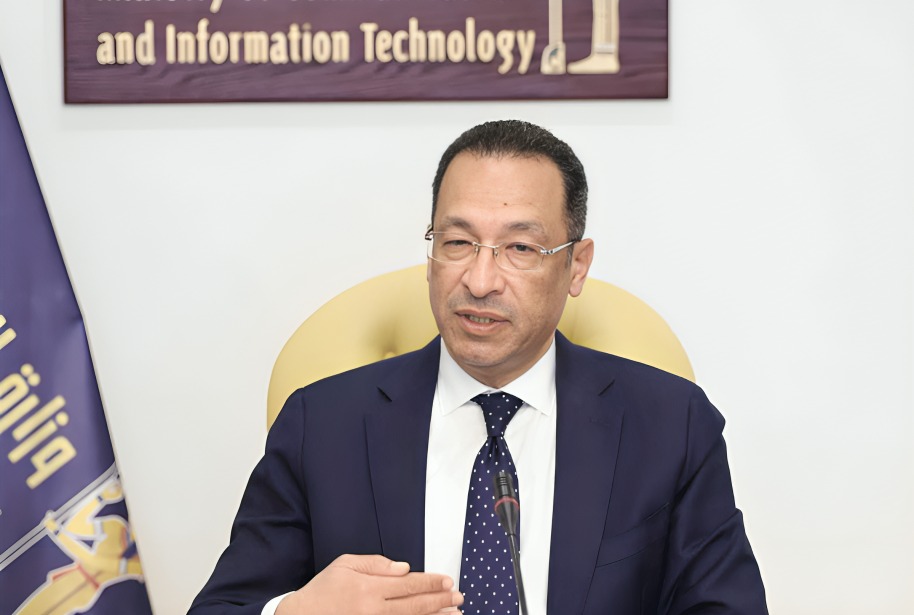
The plans were discussed during a meeting between Egypt’s Minister of Communications and Information Technology, Raafat Hindi, and a delegation from the Egyptian Businessmen’s Association led by Fathallah Fawzy, Vice Chairman of the Association and Chairman of its Real Estate Development and Contracting Committee.
The meeting focused on strengthening cooperation between the government and business community, attracting investment into Egypt’s outsourcing industry and reviewing major digital transformation projects.
Hindi said around 245 digital services are currently available through the Digital Egypt platform, with the government targeting more than 400 services by 2030. The ministry is also developing a digital identity platform that will allow citizens to complete services requiring personal verification, including powers of attorney and documentation, entirely online.
Egypt is also expanding local mobile phone manufacturing. Domestic production increased from three million devices in 2024 to around 10 million in 2025, with production expected to reach between 14 million and 15 million phones in 2026. This would cover a significant share of domestic demand estimated at between 18 million and 20 million devices while creating opportunities to expand exports.
Digital skills development remains another component of the strategy, with the ministry continuing training and capacity-building programmes for different age groups and professional categories. The programmes are intended to prepare Egyptian talent for employment opportunities both domestically and internationally.
The government is also focusing on locally developed artificial intelligence applications as part of efforts to strengthen Egypt’s digital sovereignty. These include Karnak Chat and an Egyptian language system capable of converting text to speech and speech to text in Arabic and Egyptian Arabic across 50 global languages.
The ministry has also launched the Lughat application to support English-language learning, adding to the country’s growing portfolio of locally developed digital tools.
Infrastructure development is another priority. Egypt is expanding fibre-optic coverage across its governorates and extending networks to villages covered by the Haya Karima presidential initiative. The government is also preparing an integrated data centre strategy that is expected to be launched by the end of 2026, while cybersecurity remains a key focus for protecting digital infrastructure and systems.
Egypt’s outsourcing industry is central to the country’s digital economy ambitions. Hindi said outsourcing exports reached $5.1 billion by the end of 2025, with the government targeting $8 billion by 2028 as international companies continue to show interest in expanding operations in Egypt.
Ahmed El-Zaher, CEO of the Information Technology Industry Development Agency (ITIDA), said employment in the outsourcing sector has grown from approximately 90,000 specialists in 2021 to more than 195,000 currently.
ITIDA is working with local and international outsourcing companies to expand operations and create employment opportunities. Agreements signed with 55 global companies are expected to generate around 75,000 additional jobs.
The expansion is also moving beyond Cairo, with outsourcing companies increasingly establishing operations in other governorates. This is intended to broaden access to Egypt’s talent pool and distribute employment and investment opportunities across the country.
The meeting also examined Egypt’s National Real Estate Identification Number system, which assigns a unique identification code to every property, residential unit and plot of land. The system is designed to prevent duplication, strengthen property ownership records and improve the delivery of government services.
Mahmoud Badawy, Assistant Minister for Digital Transformation, said national identification numbers have already been generated for all buildings across Egypt, while a large number of property units have also been covered through links with utility data.
Members of the Egyptian Businessmen’s Association welcomed the ministry’s work to advance digital infrastructure and integrate technology across government institutions. They said continued digitalisation could reduce paper-based processes, cut bureaucracy and create a more efficient environment for businesses, investors and property developers.
The government’s plans bring together digital public services, local technology manufacturing, AI development, connectivity, cybersecurity and outsourcing as part of a broader effort to strengthen Egypt’s digital economy. With targets for expanding government services, increasing outsourcing exports and creating new technology jobs, digital transformation remains a major component of the country’s economic development agenda.