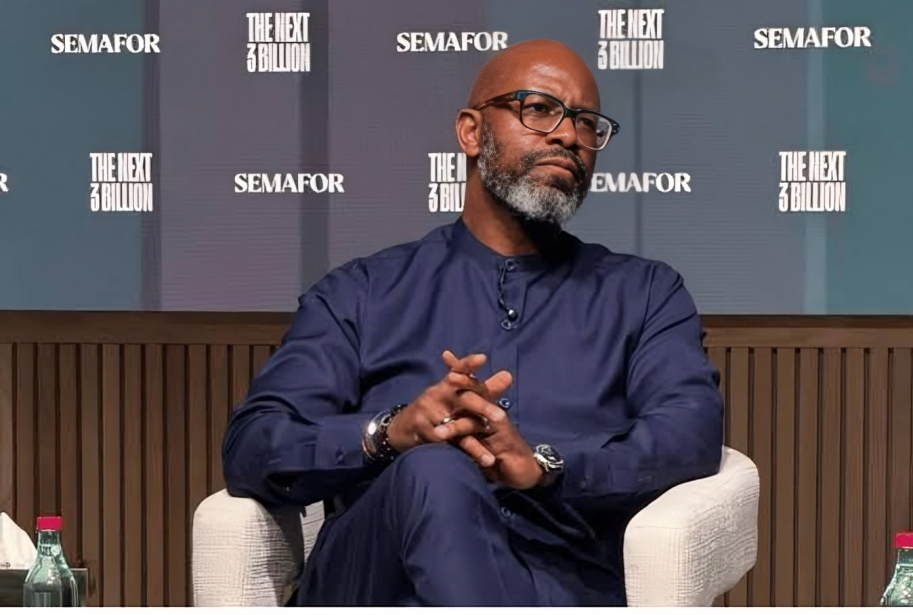


MTN Group President and Chief Executive Officer Ralph Mupita has outlined plans to expand digital connectivity, financial services and technology infrastructure across Africa under the company’s Ambition 2030 strategy, including targets to add up to 70 million active data subscribers and connect up to 30 million additional homes.
Speaking at SEMAFOR’s The Next 3 Billion event, Mupita discussed the barriers preventing wider digital adoption across the continent, despite the economic contribution of mobile technologies and the continued expansion of broadband networks.
He said mobile technologies contributed approximately US$240 billion to Africa’s economy in 2025. However, nearly one billion people remain offline despite broadband network availability, highlighting the difference between infrastructure coverage and actual digital adoption.
Mupita identified the cost of connectivity, limited access to devices, inadequate digital skills, a lack of relevant services and trust concerns as key obstacles. He argued that addressing these challenges would require more than expanding network coverage, with greater attention needed on affordability, accessibility and the practical value of digital services.
He also highlighted the need to move beyond basic digital account ownership towards more active use of financial and digital services. These include digital payments, credit, remittances, insurance and e-commerce, which can help individuals and businesses participate more fully in the digital economy.
Under Ambition 2030, MTN plans to increase its active data subscriber base by up to 70 million and connect as many as 30 million additional homes. The company also intends to grow its Mobile Money (MoMo) financial services business, which already has approximately 70 million monthly active users.
The strategy places connectivity and financial services expansion alongside investment in the infrastructure needed to support increasing demand for digital applications and services.
On telecommunications infrastructure, Mupita called for investment-led competition policies, arguing that industry consolidation may be necessary to sustain the level of investment required for 5G, fibre networks and infrastructure capable of supporting artificial intelligence applications.
He also described low-earth-orbit satellite technology as complementary to terrestrial networks, highlighting the importance of consistent regulation across different connectivity technologies.
Artificial intelligence was another focus of his remarks. Mupita highlighted the need for local computing infrastructure, reliable electricity, connectivity and skilled workers to support AI adoption across African markets. These elements will be important in enabling businesses and institutions to use AI technologies and develop applications suited to local needs.
As part of its infrastructure expansion plans, MTN is targeting a US$1 billion to US$2 billion data centre joint venture and additional fibre corridors. The company is also targeting more than R30 billion in AI-related value creation by 2030.
The investment plans reflect MTN’s intention to expand beyond conventional mobile connectivity into data infrastructure and emerging technologies. Data centres and fibre networks are expected to form part of the infrastructure supporting cloud services, AI applications and other data-intensive digital activities.
Mupita said coordinated investment in inclusive digital infrastructure would be essential to translating Africa’s growing digital access into wider economic opportunities.
Through Ambition 2030, MTN is seeking to increase data adoption, extend home connectivity, expand financial services and strengthen the infrastructure needed to support Africa’s digital economy.